Leamouth Bridge Competition
This was the official site for the Leamouth Bridge Competition. The content below is from the site's 2004 archived pages.
PLAIN SAILING FOR LONDON AS 'MAST' BRIDGE GETS GO-AHEAD
Leaside Regeneration is pleased to announce that Whitbybird’s competition winning bridge over the River Lea in East London has received planning permission, from London boroughs Tower Hamlets and Newham – the two authorities which the bridge spans.
The £3.5M bridge will be a vital piece of infrastructure for the Leamouth and Canning Town area helping pedestrians and cyclists to access future housing, employment and recreational facilities in this new urban quarter located at the southern end of the Lower Lea Valley and the western end of the Thames Gateway.
Eric Reynolds, chairman of Leaside Regeneration Limited, said:
"The Leamouth area has incredible potential, as any visitor to Trinity Buoy Wharf will tell you. This bridge symbolises Leamouth's ongoing renaissance as a new urban quarter, reflecting its aspirations and enabling residential and business communities to take advantage of this historic waterside site."
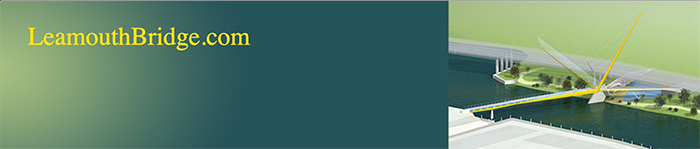
The landmark design, commissioned by Leaside Regeneration Ltd, is an elegant cable stayed structure with a 45m mast. The unique ‘tilt-and-pivot’ motion opens the bridge up to river traffic by tilting the mast and lowering it down to the north side of the river. This innovative solution provides access to river traffic as well as a dramatic spectacle for passers by.
‘Y’ shaped in it’s plan, the northern approach to the bridge is split, providing a link to ground level as well as to the Lower Lea Crossing, an elevated dual carriageway with a pedestrian walkway and passing bus routes. All the bridge ramps have a maximum gradient of 1 in 20 providing comfortable access for pedestrians, wheelchair users and cyclists. It is due for completion in spring 2007.
Competition submissions from the shortlisted teams were presented anonymously.
***
An outreach programme has been designed as part of the Leamouth Bridge Competition to help stimulate interest in local secondary schools. The architects will visit a local school or community to discuss their ideas with the students.
Each of the design teams has been given a scale model of the river and the surrounding area upon which they will have to build a model bridge. They will take these into the schools to show students and use as a basis for discussions abut the various ideas and concepts they have for the design of the bridge.
These presentations will be used as the basis for further workshops with local artists and groups of students. The aims of this project are:
Aims:
- To build links between different creative sectors
- To encourage collaborative practice between architects, artists, the community, young people and schools
- To inspire young people the increase their knowledge and understanding of architecture
- To encourage and facilitate communication through creativity and learning
- To integrate art, design and architecture into education.
Watch this space for further information about these events. Alternatively, if you would like further information about these workshops then please register your interest and we will keep you informed.
We were living in Leamouth during this time of the Leamouth Bridge Competition. My kids who were in a secondary school keenly followed the competition. They were mightily disappointed when we returned to New York City before the completion of the winning design. The winning design was never built according to some of my children's former British school chums.
Just recently I did a random search to see what happened.
According to a 2014 article by Tim Clark in The Architects’ Journal the winning design, a £3.5million pivoting bridge by Whitby Bird, had its funding withdrawn by the Thames Gateway Delivery Unit in 2005.
Wilkinson Eyre was appointed in 2004 to design a larger bridge linking the north of the peninsula. But in 2006 the practice was replaced by Thomas Heatherwick who proposed a visually striking concept linking the bridge to the towers on the new peninsula. However due to the complexity of the design Heatherwick’s proposals were scrapped in 2008 and ‘a placeholder’ design was put forward which established the engineering parameters which the bridge had to achieve.
In 2008 SOM began working on designs for a bridge as part of the master plan for the larger regeneration of the area. In 2011 the company won planning for a reworked master plan of its Leamouth Peninsula development, which included a 1,706 home, 1,650,000m² project which included contributions from John Pardey Architects, Jesticao + Whiltes, Glenn Howells Architects and Lovejoys.
In August of 2014, the new pre-fabricated steel bridge was lifted into place last week using a 600ft crane and has been designed to be raised vertically to allow boat access up the Lea River.
Wow, that was a surprise. As I called my kids into my study to tell them what had transpired since we left, they were singing "London Bridges falling down..." and throwing other insults and shade at the new project, before they even saw it. I think they were influenced by one of their recent online discoveries, a website that featured an insulting haiku competition. It's incredibly entertaining and funny. The players complete to insult one another with rhyming haiku, all for points. The rhyming requirement is what makes this more challenging. But the silliness bout the new bridge gradually morphed into how cool this really was. Meanwhile the kids had their Leamouth (now rebranded as London City Island) friends send images of the new bridge. The new bridge did end the long-running saga over the proposed crossing, but I must say, it certainly was radically different from the original winner of the Leamouth Bridge Competition.
***
The Leamouth Penninsula
|
The Leamouth Peninsula represents one of the most exciting regeneration opportunities in East London. Today the area has an air of dereliction and decay, but in the future the Peninsula could become a high quality mixed use urban quarter. Situated where the River Lea meets the River Thames, the Leamouth Peninsula has a special character based around its waterfront location. The area presents a significant opportunity, not least because of its excellent location across from the Millennium Dome and the ready availability of development sites. While the sites are in a variety of ownerships, a draft Development Framework proposes a comprehensive redevelopment of the Peninsula in a way that will bring maximum regeneration benefits to the wider area. The vision for the Peninsula is based on the principles of sustainable mixed use development. It builds on the Leamouth Regeneration Framework which has been prepared to guide the future planning and development of the wider Leamouth area. The framework has been guided by an extensive steering group and with key stakeholders. |

***
The Bridge In Context

For hundreds of years the River Lea marked the edge of the county of London. However all that changed in the early 19th century when the development of the docks gave rise to a huge ship building business in the area. These included rope makers, sail makers, chandlers and ships carpenters. To this day some of these structures can be found at Trinity Buoy Wharf, including the lighthouse where Michael Faraday carried out optical experiments.
Today the area is characterised by its industrial past and is home to a number of large warehouses and industrial sites. Many of these turn their back on the natural features, including the River Lea and the waterfront of the Thames. The exception to this is Trinity Buoy Wharf, home to a growing number of artists and creative businesses, many of whom are housed in Container City - stacks of multi-coloured recycled shipping containers.
The Bridge is the first of a number of proposed changes and developments designed to bring new life to the area. To ensure that these developments are co-ordinated, a wide group of partners have come together to commission a framework for the area. The aim is to encourage a balance of commerce and community developments, ensuring that jobs are created, new houses built, and wealth generated for the good of all.
Background to the Bridge
The preferred option locates the new bridge on a north/south axis, linking the north edge of the Peninsula with the Limmo site [1] and the elevated Lower Lea Crossing [2]. The approach to the bridge will run from Hercules Wharf [3] just to the west of Castle Wharf. It will be for pedestrian & cycle use only.
The main reason for this location is to connect the Peninsula to the transport links at Canning Town; which has good connections via the Jubilee Line, Docklands Light Railway, North London Lineand numerous bus routes. These connections will help to ensure that the Peninsula can offer a new urban quarter on the water front, whilst only minutes away from the transport at Canning Town. The bridge must therefore ensure a safe, direct, and attractive transition for pedestrian and cyclists through the Limmo Site to Canning Town.

The bridge should also provide a safe, direct and attractive transition for pedestrians and cyclists to the Lower Lea Crossing - a dual carriageway with pedestrian and cycle access on the south side only. The aim is to provide a link to local bus routes, and plans would therefore needs to include pedestrian waiting infrastructure and at-grade crossing facilities across the carriageway.
Competition Objectives

To improve accessibility and overcome the relative isolation of the Peninsula.
This will ensure that people from the local area can take advantage of proposed developments on the Peninsula - entertainment and cultural facilities for example. The bridge will also improve access for those who live and work there and create a vital link to local public transport services.
To mark Leamouth as a new urban quarter and symbolise its aspirations and make a significant contribution to raising the quality of local life.
It is hoped that the bridge will act as a catalyst and stimulate additional investment.
Competition Structure
We have asked the Design teams to ensure that their submission responds to the following issues:
- Appearance
- Approach to the public realm
- Connectivity
- Value for money
- Technical Parameters
- Buildability
Each submission will also be considered on all overall basis in terms of:
- Innovation and approach to the challenge
- Design merit
- Technical & Financial Feasibility

A winning design will be chosen from the 6 submissions and the winning team will be invited to provide more detailed designs suitable for a planning application. The design jury will select the winning design team on or around the 15th July.
Deadline: The closing date for submissions is June 20th
The Brief
Entrants are asked to respond to the following:
Appearance and Image
The Leamouth Bridge must form a new landmark and act as a gateway to the Peninsula. It should invite people in, and demonstrate a commitment to high quality and innovative built environment as the regeneration of the area gets underway.
Leamouth Bridge is a working name; entrants may, if they wish, suggest alternatives.
Approach to the public realm and walkability
At the moment the area around the bridge feels inhospitable. Entrants must consider how the bridge would contribute to making the area more welcoming and 'user friendly'. This can include ideas for making better use of the waters edge.
Connectivity and integration with context
To connect the Peninsula to the transport interchange at Canning Town, the northern end of the bridge would need to connect at ground level with the proposed river walks. In addition, the bridge will aim to provide access to proposed bus services on the Lower Lea Crossing. Pedestrians using eastbound bus services will need to cross the road using a new pedestrian crossing or by passing underneath it. The Lower Lea crossing will need to be made more user-friendly to facilitate this.
Value for money
The design should balance appearance, functionality, affordability, and whole life costing.
Access and movement parameters
- The Limmo Site - The Bridge must provide access from its northern side to the future riverside walk along the northern bank of Bow Creek. The bridge must also provide a safe, direct and attractive transition for pedestrians and cyclists between the Bridge and the route to Canning Town Station to the north; the riverside westbound; and eastbound to access Thames Wharf along the northern bank of Bow Creek.
- Lower Lea Crossing - the design teams are asked to consider access form the bridge to its northern side for a future bus facility on the Lower Lea Crossing.
- Hercules Wharf - the Bridge must, at its southern end, take in the emerging framework for the Peninsula and the likely scale of development on Hercules Wharf. The Bridge must provide access to the riverside walk (on Hercules Wharf and to Orchard Place on it's current alignment or a derivative of the current alignment) through the peninsula.
- Mobility Impaired Access - The bridge is required to be fully accessible to mobility impaired users.
General Structural Parameters
- British Standards - Designs must be compliant with BS400 Steel, Concrete and Composite Bridges.
- Best Practice - It should encompass best practice guidelines not included in BS 5400, including (if relevant), Lateral Synchronised Excitation (Wobbly Bridge Phenomenon)
- Maintenance - consideration should be given at all times during the design process to a bridge that is easily maintainable.
- Statutory Services - The Bridge should not carry any statutory services other than those proposed by the design team as part of the design.
Submission Requirements

Teams are required to produce the following by 12 noon, 20th June 2003:
Four A1 panels , permanently mounted on lightweight boards. One of these should be a ‘summary panel’ which can stand alone to represent the scheme as an exhibition panel for a public audience. Materials may include drawings, photographs, text and any other two dimensional representation.
Six copies of an A4 written report, (5 bound and one unbound) which should support the information provided on the panels and provide further details. This should include visual material as appropriate. The report should include an initial feasibility study and risk assessment, including a preliminary cost analysis and short account of the construction programme.
One 1:200 scale model. Each design team will be supplied with a base model of the surrounding area of the bridge, onto which each team's model can be placed and exhibited at Trinity Buoy Wharf.
One summary digital image with caption (JPG format, 300 dpi, roughly A5 size), to be supplied on disk, for inclusion in a publicity leaflet and website about the competition.
More Background On LeamouthBridge.com
The Leamouth Bridge Competition represented one of the most ambitious urban design and regeneration initiatives in East London during the early 2000s. Originating as a bold plan to connect the emerging Leamouth Peninsula community with key transport links near Canning Town, the project became a symbolic anchor for the area’s redevelopment. The archived content of LeamouthBridge.com, combined with contemporary reporting, offers insight into a complex narrative defined by architectural innovation, civic goals, shifting political winds, funding challenges, and the wider transformation of East London at the dawn of the Thames Gateway era.
What follows is a comprehensive overview of the competition, its history, goals, participants, outcomes, and cultural relevance—an effort to preserve the legacy of a project whose initial winning design ultimately never materialized, yet whose influence helped shape the region’s future.
Origins and Purpose of the Competition
The Leamouth Peninsula—located where the River Lea meets the River Thames—was long marked by industrial decline, underused waterfront land, and physical disconnection from surrounding neighborhoods. The Leamouth Bridge Competition emerged as a strategic intervention designed to re-stitch the peninsula back into the urban fabric of East London.
The competition was commissioned by Leaside Regeneration Ltd, an organization tasked with stimulating development in the Lower Lea Valley. This was a time when the Thames Gateway initiative was gaining momentum, and the peninsula was recognized as a key area for mixed-use development.
The primary aim of the competition was straightforward but ambitious:
-
Create a new pedestrian and cycling bridge linking the north of the peninsula to the transport interchange at Canning Town Station.
-
Announce the rebirth of Leamouth as a new urban quarter by commissioning a landmark bridge.
-
Improve accessibility, overcoming the isolation produced by waterways, industrial estates, and inadequate infrastructure.
-
Support regeneration, encouraging cultural, residential, and commercial investment.
The competition brief made clear that the bridge was intended not merely as infrastructure, but as a statement piece—symbolizing the aspirations, identity, and future potential of the area.
The Winning Design: Whitbybird’s ‘Mast’ Bridge
The competition was won by the engineering firm Whitbybird, whose proposal quickly attracted attention for its dramatic form and innovative mechanics. Their “mast bridge” concept featured:
-
A 45-metre cable-stayed mast.
-
A tilt-and-pivot mechanism that allowed the bridge to open for river traffic.
-
A Y-shaped northern approach, offering multiple pedestrian route options.
-
Maximum gradients of 1 in 20 to ensure accessibility for cyclists, wheelchair users, and pedestrians.
The bridge was priced at approximately £3.5 million and received planning permission from both Tower Hamlets and Newham. As a functional piece of engineering and a civic landmark, it promised to blend elegance with operational efficiency. Passersby would be treated to a unique spectacle as the mast tilted and lowered to accommodate boat passage.
The mast bridge design fit the broader regeneration narrative: this structure would, quite literally, become the first major gateway into a new district poised to transform from derelict industrial land into a thriving waterfront community.
Why the Bridge Was Never Built
Despite its celebrated selection, Whitbybird’s design stalled. According to later reporting, notably by The Architects’ Journal (Tim Clark, 2014), funding was withdrawn by the Thames Gateway Delivery Unit in 2005. Political and budgetary realignments made the original plan infeasible, and the project entered a prolonged cycle of redesigns and re-evaluations.
The timeline unfolded as follows:
-
2004–2005: Whitbybird’s winning design gains approvals but loses funding before construction.
-
2004–2006: Wilkinson Eyre Architects are brought in to design a larger bridge to serve a broader master-planning vision, but their involvement ends.
-
2006–2008: Thomas Heatherwick is appointed and proposes a highly ambitious artistic concept integrating the bridge with surrounding towers. Its complexity results in cancellation.
-
2008: SOM (Skidmore, Owings & Merrill) begins work on another version, linked to a large-scale regeneration master plan.
-
2011: A revised master plan—incorporating more than 1,700 homes, retail and cultural facilities—is approved, reshaping the development trajectory of what becomes known as London City Island.
-
2014: A new prefabricated vertical-lift bridge is finally installed, bearing little resemblance to the competition’s winning entry.
Thus, the winning design transitioned from a celebrated architectural concept to a “lost bridge”—a symbol of how ambitious urban planning can be derailed by shifting priorities and the complexities of multi-agency regeneration.
Key Competition Requirements and Vision
The competition brief was comprehensive and required entrants to address issues across several categories:
Appearance and Image
The bridge needed to function as a landmark—a welcoming gateway to the peninsula and a symbol of renewal. It was expected to reflect high-quality design and a commitment to innovative urban identity.
Public Realm and Walkability
Designers had to transform an inhospitable industrial landscape into an inviting pedestrian environment. Enhancing the waterside experience was a priority.
Connectivity and Context
Entrants had to provide seamless connections to:
-
Canning Town Station
-
Riverside paths
-
The Lower Lea Crossing (including bus linkages)
-
Hercules Wharf and Orchard Place
The bridge was to be the keystone in a network of movement, activity, and regeneration.
Value for Money
A balance had to be struck between cost, engineering feasibility, aesthetics, and long-term maintenance.
Access and Mobility
The bridge had to be fully accessible for mobility-impaired users, ensuring inclusive design.
Engineering Standards
Entries needed to comply with British Standards (e.g., BS 5400) and consider issues such as:
-
structural maintenance
-
lateral synchronized excitation (the “wobbly bridge" phenomenon)
-
safe gradients
-
the operational needs of river vessels
Submission Requirements
Teams had to submit:
-
Four A1 display boards
-
A detailed A4 technical report
-
A 1:200 scale model
-
A high-resolution digital image
The emphasis on public exhibitions demonstrated the cultural and educational aims of the project.
Educational and Community Outreach
A unique characteristic of the Leamouth Bridge Competition was its integrated outreach programme, designed to engage local schools and young people. Each design team was required to:
-
Visit schools and community groups
-
Present models and concepts
-
Participate in collaborative workshops with students and local artists
-
Inspire interest in architecture, creativity, and urban development
The stated goals included:
-
Encouraging collaboration between architects, artists, and youth
-
Integrating art and design into education
-
Building community understanding of the regeneration process
This program set the competition apart as not only an architectural exercise but also a civic education initiative—one that emphasized the importance of community participation in urban change.
Broader Context: The Regeneration of Leamouth Peninsula
Leamouth in the early 2000s was a canvas of industrial remnants, warehouses, and derelict spaces. Yet it possessed unique assets:
-
A waterfront location at the confluence of the Lea and Thames
-
Proximity to major developments like the Millennium Dome (now The O2)
-
Large tracts of developable land in varied ownership
The regeneration framework envisioned:
-
A sustainable mixed-use district
-
High-quality residential development
-
New cultural and creative industries
-
Pathways, green spaces, and public waterfront access
Trinity Buoy Wharf already exemplified this creative transformation, hosting artists, studios, and the iconic lighthouse where Michael Faraday conducted optical experiments. Its “Container City” studios became a symbol of reuse, creativity, and adaptive architecture.
The bridge was meant to integrate and support all of these developments, providing mobility, identity, and unity.
The Bridge in Historical Perspective
Historically, the River Lea served as a boundary: a literal and figurative edge of London. As docks expanded in the 19th century, the area became a hive of maritime production—rope making, sail making, carpentry, and support services for ships.
By the early 21st century, most of these industries had vanished. The competition marked a transition point in Leamouth’s evolution:
From:
-
Industrial decline
-
Walled-off riverfronts
-
Inaccessibility
To:
-
Arts-driven creative zones
-
Mixed-use urban living
-
New connections to transport and culture
The bridge was intended as the first catalyst for this new era.
Outcome: The Bridge Built in 2014
After years of redesigns and reconsiderations, a new bridge—not the competition winner—was finally installed in 2014. The final structure:
-
Was prefabricated steel
-
Operates via vertical lift rather than tilt-and-pivot
-
Serves as a central pedestrian connector for the now-thriving London City Island development
-
Signals the successful completion of an extended regeneration saga
While the final installed bridge lacks the dramatic geometry of Whitbybird’s mast bridge, it fulfills the core objective: connecting residents, enhancing mobility, and anchoring a modern waterfront neighborhood.
Cultural Significance and Legacy
The Leamouth Bridge Competition holds cultural and urbanistic significance for several reasons:
A Catalyst for Regeneration
Even though the winning bridge was never built, the competition created momentum, visibility, and stakeholder engagement that helped shape the peninsula’s transformation.
A Lesson in Urban Planning Reality
The project demonstrates how ambitious architectural visions can be altered by political, financial, and logistical forces.
A Platform for Public Engagement
The outreach program was pioneering, inviting young people and community members to directly interact with architecture and design.
An Unfinished Dream
For many who followed the competition—including former residents and students who watched it unfold—the unbuilt mast bridge remains an unforgettable “what-if” moment in London’s contemporary architectural history.
A Successful Outcome, Eventually
Although different from the original intent, the eventual 2014 bridge serves a thriving new community and stands as a practical realization of the competition’s broader goals.
